
Puedes leer este artículo en español en este enlace: ¿Los tiburons toro comen personas?
Do Bull Sharks Eat Humans? What to Know Before a Bull Shark Tour
Do bull sharks eat humans? Humans are not part of a bull shark’s normal diet, but bull sharks can bite people and cause serious or fatal injuries. Understanding both facts is essential: these animals deserve respect, without the exaggerated “man-eater” image that often surrounds them.
NOAA explains that people are not normal prey for sharks. However, that does not mean every shark encounter is predictable or that entering the water with a large predator carries no risk.
For travelers considering a bull shark tour in Playa del Carmen, learning about these animals is a useful first step. Before booking a dive, it helps to replace common assumptions with a clearer understanding of their diet, behavior, and the experience of observing them underwater.
What Do Bull Sharks Eat?
Bull sharks, scientifically known as Carcharhinus leucas, are opportunistic predators. Their diet varies according to the prey available in their environment.
According to the Florida Museum of Natural History’s bull shark species profile, bony fish and smaller sharks make up most of their diet. They can also consume rays, turtles, crustaceans, and other animals.
They are opportunistic feeders targeting other sharks, bony fishes, turtles, birds, dolphins and terrestrial mammals. It does not mean that a bull shark automatically treats everything it encounters as food.
The bull shark prefers to live in shallow coastal waters less than 100 feet deep (30 m), but ranges from 3-450 feet deep (1-150 m). Bull sharks live in coastal marine waters and estuaries, and they can also enter freshwater rivers. This adaptability helps explain why they sometimes occupy areas that people use for swimming, fishing, and other activities.
Why Do Bull Sharks Have a Dangerous Reputation?
Bull sharks are powerful animals whose habitat can overlap with human activity. Their size, teeth, and presence in coastal environments make encounters with them a serious consideration.
The International Shark Attack File identifies bull sharks among the species implicated in serious and fatal bites. It also cautions that identifying the species involved in an incident can be difficult, so records should be interpreted carefully.
Two distinctions matter here. First, a bite does not automatically establish that a shark intended to consume a person. Second, uncertainty about an animal’s motivation does not reduce the severity of the injuries it can cause.
It would therefore be misleading to describe bull sharks as harmless but also to suggest that they seek out humans as food. A responsible understanding acknowledges their capabilities without turning every encounter into a story about predation.
Why Might a Shark Bite a Person?
There is no single explanation for every shark bite.
The Smithsonian Tropical Research Institute describes curiosity and defensive responses among the reasons sharks may bite people. Human interference, including attempts to touch or feed an animal, can also create dangerous situations.
These explanations apply to sharks generally. They should not be used to claim that every bull shark incident is an accident, an exploratory bite, or a case of mistaken identity.
The Florida Museum’s shark attack FAQ discusses different encounter patterns and distinguishes incidents involving human provocation from those classified as unprovoked. That distinction helps researchers study encounters, but it does not make individual shark behavior easy to predict.
For visitors, the practical lesson is straightforward: respect the animal’s space and take the conditions of the activity seriously.
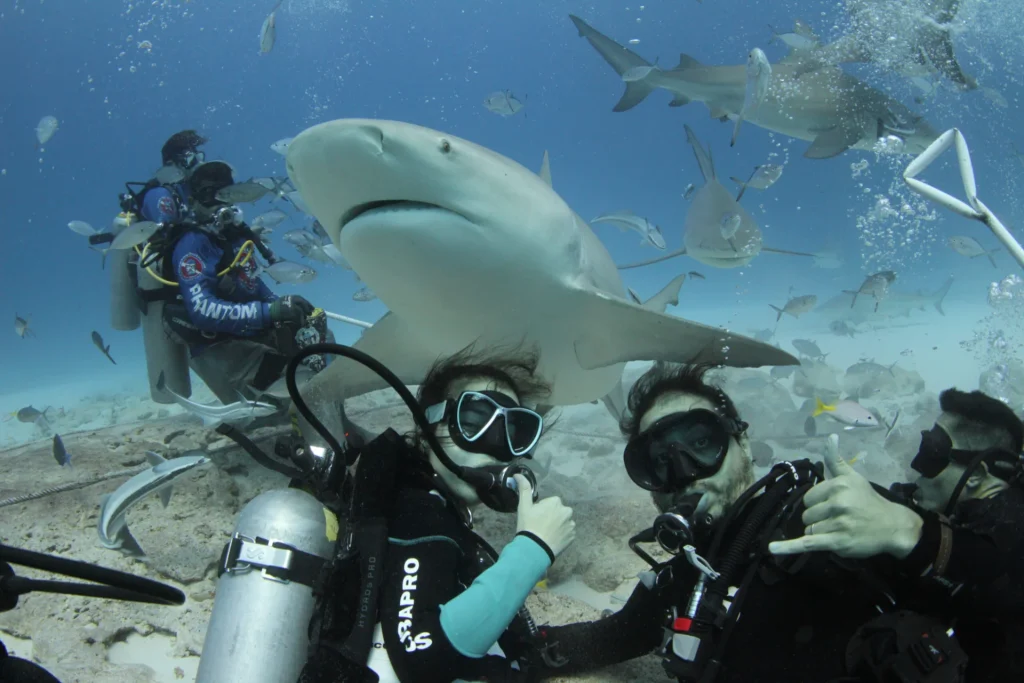
Bull Shark Diving in Playa del Carmen
Phantom Divers identifies November through March as the seasonal window for its bull shark diving experiences in Playa del Carmen. Visitors planning a trip during this period can contact the team in advance to check availability and conditions.
A bull shark tour should be understood as a specific diving activity with its own requirements. The experiences listed by Phantom Divers are scuba dives, rather than casual swimming or snorkeling excursions.
There are also differences between tour formats:
- Bull Shark Encounter: A static dive at around 80 feet involving fish attraction, designed for Advanced divers or Open Water divers with more than 20 logged dives.
- Bull Shark Discovery: A drift dive at around 60 feet that does not use bait or attraction, open to certified Open Water divers.
Certification and experience requirements vary by activity. We accept most certificacions as PADI, SSI, NAUI, CMAS, etc.
Review the Phantom Divers shark diving options and confirm which experience fits your qualifications before booking.
What Should You Ask Before Booking?
Choosing a tour involves more than selecting a date. Before reserving, make sure you understand the experience being offered and what participation requires.
Useful questions include:
- What certification and recent diving experience do I need?
- What depth and underwater conditions should I expect?
- Does this particular experience involve bait or feeding?
- What procedures will the briefing cover?
- What equipment should I bring or rent?
- What happens if weather conditions change or sharks are not seen?
Discuss any uncertainty about your diving skills before committing to the activity. Being comfortable with a plan means understanding it, rather than assuming you will work everything out once you enter the water.
Underwater photography deserves the same preparation. If taking pictures is important to you, ask how cameras fit into the dive procedures. The opportunity to capture an image should never replace attention to the briefing or the group’s instructions.
Can a Bull Shark Tour Be Completely Risk-Free?
No wildlife encounter or scuba dive can honestly be described as completely risk-free.
A professional briefing, suitable participant experience, and clear procedures are important parts of planning an encounter. They do not turn a wild animal into a predictable attraction.
Likewise, general shark bite statistics cannot tell you the exact risk of a particular dive. Location, conditions, activity, and the circumstances of the encounter all matter. Avoid treating a broad statement such as “shark bites are rare” as a guarantee about an individual experience.
A better approach is to ask questions, understand the requirements, and make an informed decision about whether the activity suits you.
Seeing Bull Sharks Beyond the Headlines
The question “Do bull sharks eat humans?” often comes from understandable concern. It is worth answering carefully, rather than dismissing that concern or amplifying it with sensational language.
Bull sharks are predators with their own feeding habits and habitat needs. Their presence in the ocean is about their lives, rather than the stories people tell about them.
NOAA also highlights the ecological value of sharks and the pressures that fishing places on some populations. Learning about these animals can help visitors appreciate why understanding them matters beyond a single holiday experience.
Whether you eventually choose a dive or prefer to keep learning from shore, accurate information offers a more useful perspective than fear alone.
Discover Bull Sharks with Phantom Divers
Would you like to discover these remarkable animals during bull shark season? Explore our available experiences and speak with our team about the option that matches your diving background.
Book your bull shark tour with Phantom Divers and take the next step toward experiencing bull shark diving in Playa del Carmen.
More Than 25 Years in Playa del Carmen
Marco Loria Erbacci y Jorge “Chino” Loria, together with Phantom Divers, was a pioneer of bull shark diving in Playa del Carmen. With more than 25 years in the area, Phantom Divers Dive Center history is part of what makes discovering bull sharks such a great experience.

